By the end of 2025, Google revealed that AI Overviews have amassed 2 billion monthly users while AI Mode has been launched in more than 200 countries and territories (Google, 2025). Also during this timeframe, the Previsible AI Traffic Report for 2025 stated that AI Search traffic increased by 527% year-on-year growth (Search Engine Land, 2025). The owners of Australian companies are following these figures and posing a justified question: do the laws of search engine optimization still apply when ChatGPT, Perplexity AI, Google AI Mode, and Gemini decide what their users see?
In this article, you will learn what is AI SEO, how it interacts with conventional SEO, and what practical actions your Australian company needs to take in order to get an advantage from the situation. We’ll cover the basics of the mechanics, figures that matter, problems that you can hear from other Australian business owners, and actions that make a difference. Without useless jargon and without any SEO is dead marketing tactics.
What AI SEO actually is (And what it isn't)
Defining AI SEO in plain terms
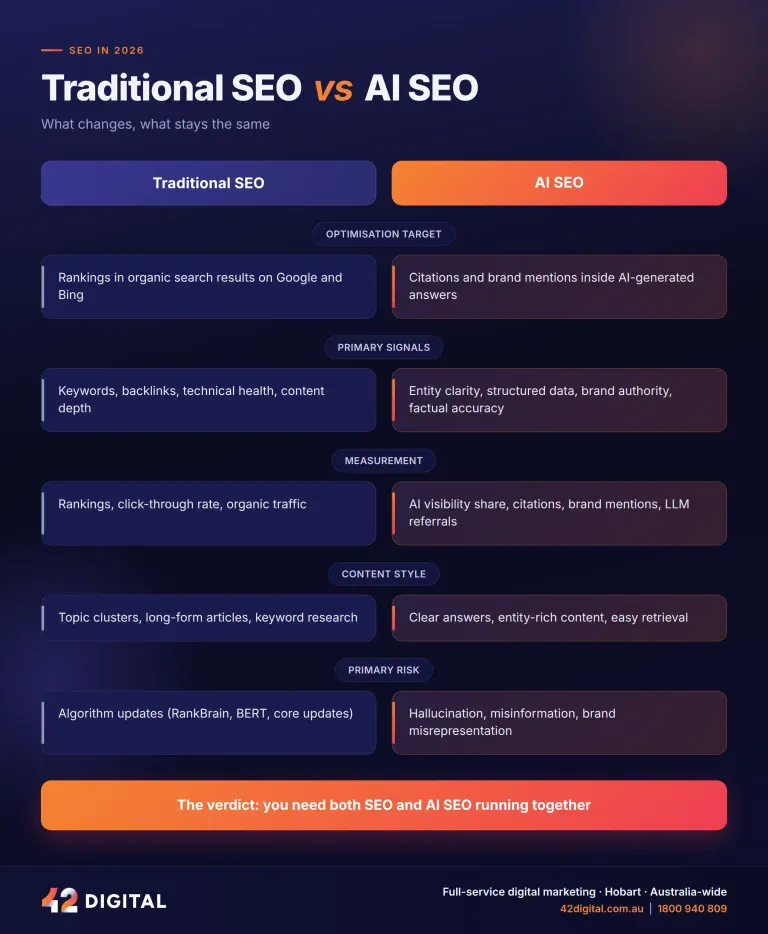
AI SEO involves optimising your website, content, and brand in order to get listed within the responses generated by AI systems such as ChatGPT, Google AI Overviews, Perplexity AI, Gemini, and Microsoft Bing Copilot. The optimisation target is earning citations and brand mentions inside the answer itself, not only ranking blue links on a search engine results page.
Traditional search engine optimisation focuses on improving where your pages rank on Google Search and other search engines like Google and Bing. SEO for AI concentrates on making your content visible within the AI to have it be retrieved, summarised, and cited by a large language model when the user queries something.
The two are supplementary; both SEO and AI SEO are required. Both forms of SEO need to be done in order to get the best possible results, as in spite of everything, till today most discoveries happen through traditional search (Google gets five trillion queries per year), and discoveries also happen using AI (ChatGPT and Perplexity).
The mechanics overlap more than you might expect. Both rely on web crawlers, search engine indexing, semantic understanding (BERT, transformer models, machine learning), and a search engine results page that has been changing for years anyway with featured snippets, knowledge panels and personalised search.
Why you need both
If you only do traditional SEO, you risk missing the share of discovery now happening inside AI tools. If you only do AI SEO, you give up the bulk of search traffic that still comes from Google’s organic search results. The sensible move is to fold AI SEO into your SEO and content workflows so both channels feed each other.
How AI Has Changed Search Behaviour
The rise of zero-click search
Roughly 60% of searches on traditional search engines now end without a click. AI summaries, knowledge panels and other SERP features answer the question right on the page, so users often don’t need to visit any website (source Bain & Company, 2025).
When Google shows an AI summary, only 8% of users click a traditional link below it, compared with about 15% when no AI summary appears. About 26% of searches with AI summaries end without any further action at all (source Pew Research, 2025). The lower click-through rate on results with AI summaries suggests that many users now treat the AI answer as the complete answer.
What Australian users are doing differently
The usage of AI chatbot technology for searching among Gen Z in the US is around 35%, while in Australia, it is following very closely (Claneo, 2025). The Gen Z generation continues using classic search engines and visual-based search tools such as Instagram, TikTok, and YouTube; however, the percentage of the searches being done via ChatGPT, Gemini, and Perplexity grows constantly. As an Australian business owner, the question to ask is whether you have coverage on all surfaces, including ChatGPT?
Trust, accuracy and the misinformation problem
Over 80% of users are at least somewhat sceptical of AI Overviews, and only about 9% always trust them. More than 40% of users say they’ve seen inaccurate or misleading content inside AI Overviews (source Exploding Topics, 2025). For brands, two responsibilities emerge: creating content that is accurate and well-researched for the purpose of ensuring that AI systems get their facts straight, and monitoring how your brand appears in the responses of AI technology.
Why this matters for Australian business owners
The traffic question
What’s the point if there are fewer clicks? Well, those who do click are worth more than the rest. It has been found out that the average value per visitor on AI searches is 4.4 times higher compared to that of the traditional organic search (Semrush, 2025). The bounce rate of AI referrals is 27% lower than that of regular traffic for retail websites (Adobe, 2025).
The opportunity hiding in the data
Half of ChatGPT’s links are references from business or service websites. The news and media sector contributes 9.5%, blogs and content websites 8.3%, and ecommerce 7.6% (Semrush 2025 AI search & SEO traffic study). For service businesses in Australia (trades, consultancy, agencies, health care, hospitality, professional services), the take on this is obvious – your content has a great chance of citation if it’s accurate and entity-rich.
Local Australian context
Australian businesses function nationally and even internationally. A roofer in Launceston, a chiropractor in Geelong, a SaaS founder in Hobart and an ecommerce brand in Perth all face the same shift. The good news is that local credibility, genuine reviews, correct business name, address, phone details, schema markup, and a well-maintained Google My Business listing all still count, and our Australian SEO services are built around exactly that mix.
How AI SEO Actually Works
Crawling, indexing and retrieval
AI platforms still depend on web crawlers and search engine indexing to know what exists on the web. Google’s web crawler feeds AI Overviews, ChatGPT uses its own crawler alongside Bing’s index, and Perplexity AI blends multiple sources. The retrieval layer turns your page into vectors and embeddings, then surfaces relevant chunks when a user asks a question.
If your site can’t be crawled (broken robots.txt, JavaScript rendering issues, slow servers, messy URL redirection), it cannot be retrieved. Technical SEO is more important than ever and it serves a foundational role in your SEO strategy.
How LLMs choose what to cite
Large language models tend to favour content that is:
- Entity-clear: the page is about a specific named thing (a product, a person, a service, a location)
- Factually consistent: claims match other reputable sources across the web
- Structurally clean: HTML headings, lists, schema markup and a logical hierarchy
- Authoritative: the brand has mentions, citations and links from credible sources
This is where semantics and entity-relationship modelling sit at the heart of modern SEO. The process of named entity recognition helps the search engine and LLM identify that “42 Digital” is a company located in Hobart, that “Hobart” is a city in Tasmania, and that “AI SEO” is a marketing field. The better the connections become understood, the more frequently will your brand be mentioned.
Brand mentions now matter as much as backlinks
In the age of search by AI, an independent brand mention on a respected website can be enough to increase your visibility. The importance of backlinks in search results has not diminished, but the importance of brand mentions and factual information on your brand is equally significant at this point. How frequently your brand is mentioned (and in what context) will determine whether it will appear in AI searches and recommendations.
AI SEO Statistics Every Australian Business Owner Should Know
- AI Overviews now reach 2 billion monthly users across more than 200 countries and territories. (Google, 2025)
- AI search traffic grew 527% year on year between January-May 2024 and the same window in 2025. (Search Engine Land, 2025)
- Traffic from AI search may surpass traffic from traditional search by 2028. (Semrush, 2025)
- Roughly 60% of searches on traditional search engines yield no clicks. (Bain & Company, 2025)
- Only 8% of users click a traditional link when an AI summary appears, compared with 15% when no summary appears. (Pew Research, 2025)
- About 88% of terms that trigger AI Overviews are informational, meaning users want to learn rather than buy. (Semrush, 2025)
- Half of ChatGPT’s cited links point to business and service websites. (Semrush, 2025)
- Almost 70% of businesses report higher ROI from using AI in SEO and content workflows. (Semrush, 2024)
- Nearly 35% of Gen Z use AI chatbots to search for information, alongside YouTube, Instagram and TikTok. (Claneo, 2025)
- ChatGPT has 700 million weekly active users and over 5 billion monthly visits, making it the fourth most visited website globally. (OpenAI, 2025)
These are the numbers that have reshaped what an effective SEO program looks like in 2026.
The 9 Pillars of an AI SEO Strategy in 2026
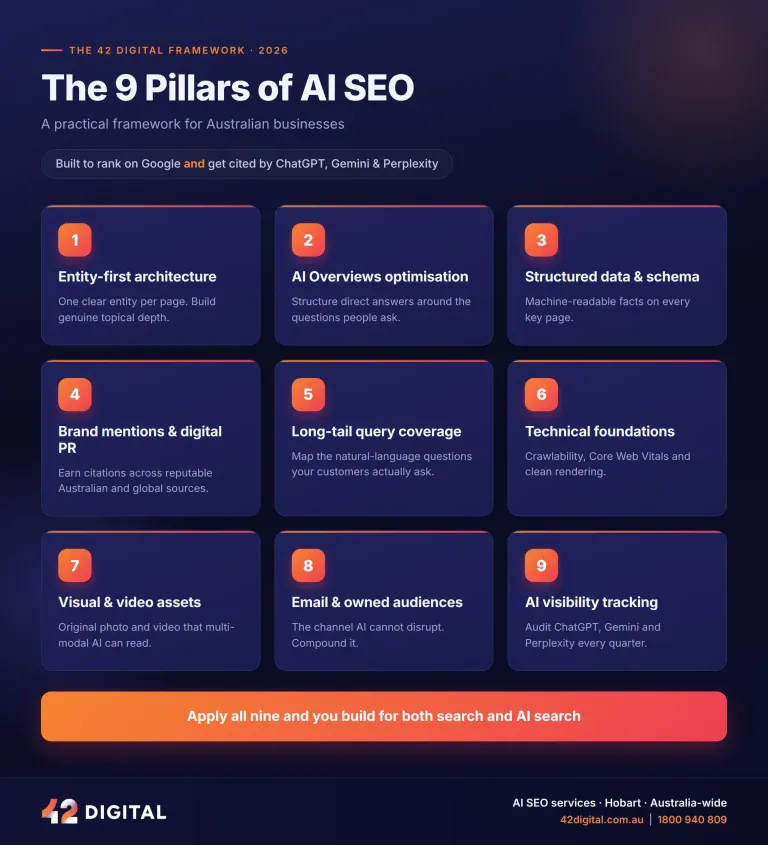
A practical framework Australian businesses can apply. The goal across all nine is to optimise for AI platforms alongside traditional search engines, with each section of your content pulling its weight.
1. Entity-first content architecture
Every page should be unambiguous about what it is, who it serves, and what entities it relates to. Use clear headings, schema markup, internal linking and consistent naming. AI platforms reward content where each section of your content covers a single, well-defined entity or sub-topic.
2. Optimise for AI Overviews and answer engines
The percentage of information-related triggers that cause the AI Overview to pop up is about 88%, while AI Overviews usually occur in low search volume, long-tail queries (Semrush, 2025). In order to optimise AI Overviews, the page needs to be built around the question and the queries/trigger terms searched by people seeking answers to their questions.
3. Structured data and schema markup
Implement Organisation, LocalBusiness, Article, FAQPage, Product and Review schema where relevant. Structured data turns unstructured data into machine-readable facts. It’s one of the strongest levers we have for telling AI platforms what each page is about. A properly built business website bakes this in from the start.
4. Brand mentions and digital PR
Gain unconnected brand mentions in trusted sources both in Australia and overseas. The more frequently your brand receives recognition from reputable sources, the higher the level of trust in your brand an LLM will have when quoting your business.
5. Conversational and long-tail query coverage
AI search rewards content that answers natural-language questions. Map the questions your customers actually ask, including comparison queries (“X vs Y”), problem-solving queries (“how to fix…”), and intent-rich queries (“best [service] in [Australian city]”). Long-tail keywords now drive a disproportionate share of AI citations.
6. Technical foundations
Crawlability, Core Web Vitals, mobile experience, HTTPS, JavaScript rendering and a clean robots.txt are non-negotiable. If a web crawler struggles, an LLM never sees your content.
7. Visual and video assets
Image processing and multi-modal AI have made it possible for artificial intelligence to process not only text but also images and videos. Photography and videography provide additional data for AI platforms and increase the probability of getting indexed in image search and video search results. At 42 digital, we create high-quality visual content using our photography services and professional videographers.
8. First-party data and email
Email is the channel AI cannot disrupt. Owned audiences (your list, your subscribers, your customers) become more valuable as paid and organic discovery get harder to predict. A well-run email marketing program compounds every other channel.
9. Measurement: tracking AI visibility alongside organic
Start tracking your AI visibility just like measuring your rankings. Using tools such as Semrush’s AI Visibility Toolkit, ChatGPT brand mentions, and manual sample audits on Perplexity and Gemini provides you with an idea of what you are up against. See how you stack up against your competition and measure the trends quarter by quarter.
Concerns we hear from Australian business owners
“My Google traffic is dropping. Is SEO still worth it?”
In most cases, yes. The shape of traffic is changing more than the value of being visible. Organic clicks may fall while AI-driven referrals and brand-led searches rise. The businesses doing well are the ones who adapt their measurement and content strategy, rather than walking away from SEO altogether.
“How long until I see ROI from AI SEO?”
The ROI timeline for AI SEO efforts depends on your starting point. A well-established site with solid technical foundations and authoritative content can begin appearing in AI Overviews and ChatGPT citations within 60-90 days of an entity-led refresh. A newer site usually needs 6-9 months for compounding results. The encouraging news is that about two-thirds of AI-assisted content begins ranking within two months (Semrush, 2024).
“Do I still need Google Ads if AI is taking over search?”
Yes, for now, and arguably more than before. With organic clicks under pressure, paid search becomes a useful hedge to control visibility on commercial queries. Most queries that trigger AI Overviews are informational rather than transactional, which means high-intent commercial keywords remain a strong paid search opportunity. We help clients balance the mix through our Google Ads management.
“I’m a small business. Can I really compete?”
Yes, even more often than one would expect. AI systems use references to business and service websites in approximately half of all cases, while rewarding quality over quantity. An organised and deep local business website is able to beat a bigger rival, which uses outdated techniques, easily.
How 42 Digital approaches AI SEO for Australian businesses
What that looks like in practice
- A single point of contact who knows your business, your customers, and your objectives, not different people every time you call in.
- Real numbers, not vanity stats. Real leads, real conversions, real growth. Anything that does not translate into either money in the bank or potential opportunities in your pipeline has no place on your dashboard.
- Honest communication upfront. We will be truthful about anything that is not working from the very beginning, because we would rather talk about it now, than spend a year fixing the problem.
- Designed to be cross-channel. We handle everything from SEO, Google Ads, social media, email marketing, web development, photography, and video all in one place. Why does this matter? Because SEO for AI isn’t just about one channel; it encompasses multiple aspects at once.
- Local roots, national reach. It is our pride to be from Hobart and to serve businesses throughout all states and territories. Not many of our clients have actually stepped inside our office. Through our reports, communications and project management skills, geography becomes insignificant.
We’ve been delivering measurable SEO and digital marketing work for Australian businesses for years, and we apply the same evidence-led approach to AI SEO. If you’d like to see how this works in practice, our SEO service page breaks down our process, deliverables and reporting cadence.
How AI SEO connects to your wider marketing mix
AI SEO doesn’t live in isolation. Each channel feeds the others.
Social media and AI discovery
Instagram, TikTok and YouTube now play a meaningful role in how Gen Z and younger Millennials discover brands. LLMs also pull from social signals when assessing brand authority. Strong, consistent posting through our social media management services keeps your brand visible on the platforms AI is increasingly reading.
Photography and videography as AI-friendly assets
High-quality original visuals strengthen your on-page experience, improve dwell time, support image search visibility, and feed your social and video channels. Original video content also opens up YouTube as a discovery channel, which Google now treats as a primary surface for AI Overviews.
Email marketing: the channel AI cannot disrupt
If AI search reduces your top-of-funnel traffic, your email list becomes the most valuable asset you own. It’s the one channel where you control delivery, segmentation and frequency. Our email marketing service helps build that asset alongside everything else.
Paid search as a hedge while AI search matures
Most queries that trigger AI Overviews carry no ads or very low CPC. The flip side is that high-intent commercial keywords (the ones with real buying intent) remain largely untouched by AI Overviews. Pairing organic and AI SEO with smart pay-per-click campaigns gives you immediate coverage on commercial queries while organic builds in the background.
Your website as the foundation
Everything above depends on the technical and structural health of your site. Schema markup, page speed, mobile usability, internal linking and content structure all originate at the build layer. If the foundation is shaky, no amount of content or paid budget will fix it. We design and rebuild sites through our web development team with AI search readiness baked in.
How to Start Tracking Your AI Visibility This Week
You don’t need a six-figure tooling budget to start tracking your AI visibility.
- Run prompt tests in ChatGPT, Perplexity and Gemini. Ask the same questions a prospective customer would ask. Note whether you appear, who appears instead, and what facts the AI gets right or wrong about your brand.
- Audit your structured data. Run pages through Google’s Rich Results Test and the Schema.org validator. Fix gaps in Organization, LocalBusiness, Article and FAQPage markup.
- Create a baseline for your AI visibility. Thanks to the Semrush AI Visibility Toolkit and competition benchmarks, you have a solid foundation. Where do you stand now relative to your competition?
- Identify your top 10 commercial entities. These are the people, products, services and locations your business depends on. Make sure every one has a dedicated, authoritative page.
- Build a feedback loop. Once a quarter, re-run the prompts, refresh the metrics, and adjust the content roadmap.
The bottom line for Australian businesses
AI is transforming the field of search, and it is the business owners of Australia that view AI SEO as an additional layer to their existing SEO efforts who will emerge victorious when customers turn to Google, ChatGPT, or Perplexity for answers.
For this quarter:
- Audit your structured data and technical foundations
- Map your top 10 commercial entities and make sure each has a strong dedicated page
- Start a monthly prompt-testing routine across ChatGPT, Perplexity and Gemini
- Strengthen your email list as your owned-channel hedge
For this year:
- Build entity-first content across your top funnels
- Invest in original photography and video as AI-friendly assets
- Treat brand mentions and digital PR with the same seriousness as backlinks
- Reweight measurement to include AI visibility, not only rankings
If you’d like an honest look at where your business currently sits on AI visibility, and what a sensible 12-month plan looks like for your industry, we’d happily walk you through it.
Book a discovery call with 42 Digital or phone 1800 940 809.
-
Will AI replace traditional search engines?
SEO is not dead. Not in the immediate future. There is a change in the way people search thanks to AI, but it is estimated that Google processes about five trillion searches every year, and most people continue to use Google Search as their go-to option. The most probable scenario is the hybrid search process.
-
Is SEO dead?
No. The discipline has evolved significantly. Ranking now involves much more (including organic placement, citations from AI search engines, and brand mention), and the work involved in creating authority and clarity has not been eliminated. Businesses which commit to SEO in this day and age have much longer runway than before.
-
Do AI Overviews appear for every query?
Not really. These searches tend to show up more frequently in information searches and long-tail searches. Transactional and commercial searches tend to show up much less than that, since Google has to preserve its ad dollars.
-
How much should an Australian business spend on AI SEO?
There's no universal number. As a rough guide, small to medium Australian businesses typically invest between $1,500 and $6,000 per month across SEO and AI SEO combined, depending on industry, competitiveness, and whether content production is included. We tailor packages based on what each client actually needs, and we'd rather scope a smaller program that delivers than oversell something you can't sustain.